Content
The Kuruman Moffat Mission
Description
The Kuruman Mof
The mission’s story began in 1816, when the London Missionary Society established its first settlement at New Lattakoo. In 1824, the mission was relocated to its present site at Seodin, where it flourished under the leadership of missionaries William Edwards, Robert Hamilton, and most notably Robert Moffat, whose name has become inseparable from the mission’s remarkable legacy. Robert Moffat arrived in Kuruman in 1820 and, together with his wife Mary Moffat, dedicated nearly fifty years of their lives to serving the local Tswana communities. Their work extended far beyond religious teaching, laying the foundations for education, literacy, agriculture, and community development throughout the region.
One of Robert Moffat’s greatest achievements was mastering the Setswana language and producing the first complete translation of the Bible into Setswana. In 1857, this monumental work was printed on the mission’s own printing press at Kuruman, making it the first complete Bible ever printed in Africa and the first complete Bible published in a previously unwritten African language. This extraordinary accomplishment not only transformed Christian missionary work across Southern Africa but also preserved and formalised the Setswana language for future generations. The mission therefore occupies a unique place in both African literary history and the cultural heritage of South Africa.
Visitors to the Kuruman Moffat Mission can admire the beautifully preserved Moffat Church, completed in 1838, which remains one of the oldest mission churches in South Africa still standing today. Constructed largely from locally sourced stone and timber, the church reflects the simple yet enduring craftsmanship of the early missionaries. The surrounding mission grounds include historic buildings, exhibits, and artefacts that provide fascinating insight into nineteenth-century missionary life, local history, and the interaction between European missionaries and the indigenous Tswana people.
The mission also holds special significance as the place where the famous explorer and missionary Dr. David Livingstone met and married Mary Moffat, Robert Moffat’s daughter, before embarking on his legendary expeditions into Central Africa. This connection further elevates the mission’s international historical importance and attracts visitors interested in the lives of two of Africa’s most influential historical figures.
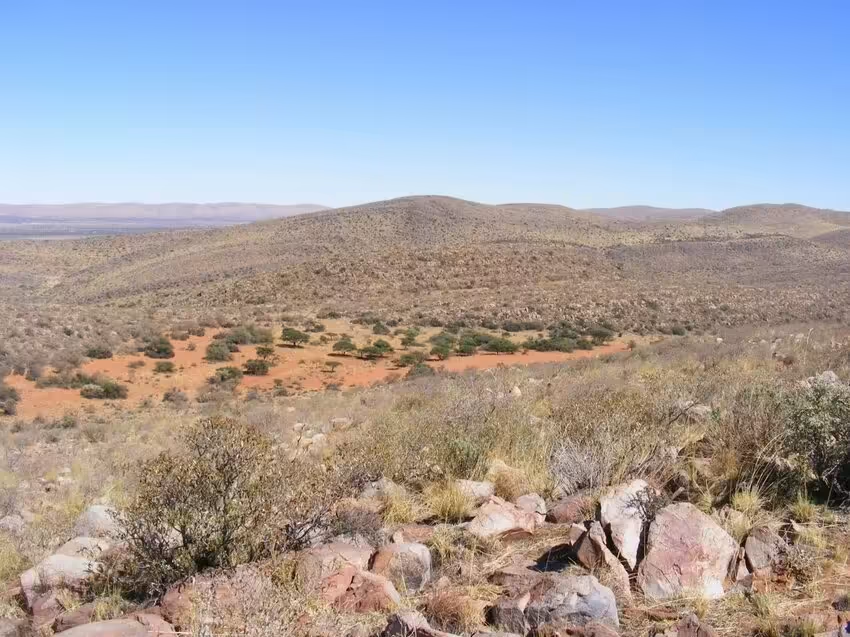
Today, the Kuruman Moffat Mission stands as far more than a historical monument—it is a symbol of education, language development, faith, and cultural exchange. Combined with nearby attractions such as the Eye of Kuruman, Wonderwerk Cave, and the spectacular Kalahari landscapes, the mission forms an essential part of any visit to Kuruman. Whether you are interested in South African history, missionary heritage, architecture, or African languages, the Kuruman Moffat Mission offers a meaningful and unforgettable journey into one of the Northern Cape’s most treasured heritage sites.
Gallery


Full Content
More Attractions and other things to see



Listing Logos